Status
"Humans evolved in hierarchical societies, and most of us acknowledge that status-seeking is a common, if sometimes regrettable, driver of human behaviour." – Steven Johnson, Wonderland
All social animals form pecking orders, and humans are no exception. Pecking orders regulate access to resources and reduce the need for constant open conflict. They stabilise a group until some shift in circumstance, power, competence, or desire unsettles the arrangement. A person's rank, her status, can be secured through competition or collaboration, and it can change from one setting to another. Someone who holds authority in one room may become hesitant or peripheral in the next.
In The Secret of Our Success, Joseph Henrich distinguishes between dominance-based and prestige-based status and argues that prestige is an evolutionary strategy in its own right, with its own logic and social function.
Prestige
Prestige-based status is achieved through freely granted deference grounded in perceived competence, knowledge, skill, or success. People choose to attend to, copy, learn from, and keep close to prestigious individuals. Henrich's central claim is that humans evolved prestige as a solution to the problem of cultural learning. In a species that survives by transmitting knowledge, it makes sense that we became highly sensitive to who is worth watching.
Dominance
Dominance-based status is achieved through coercion, intimidation, force, or the ability to impose costs on others. This form of status is widespread across primate species and human societies alike. It relies on pressure. Others yield because resistance carries a price.
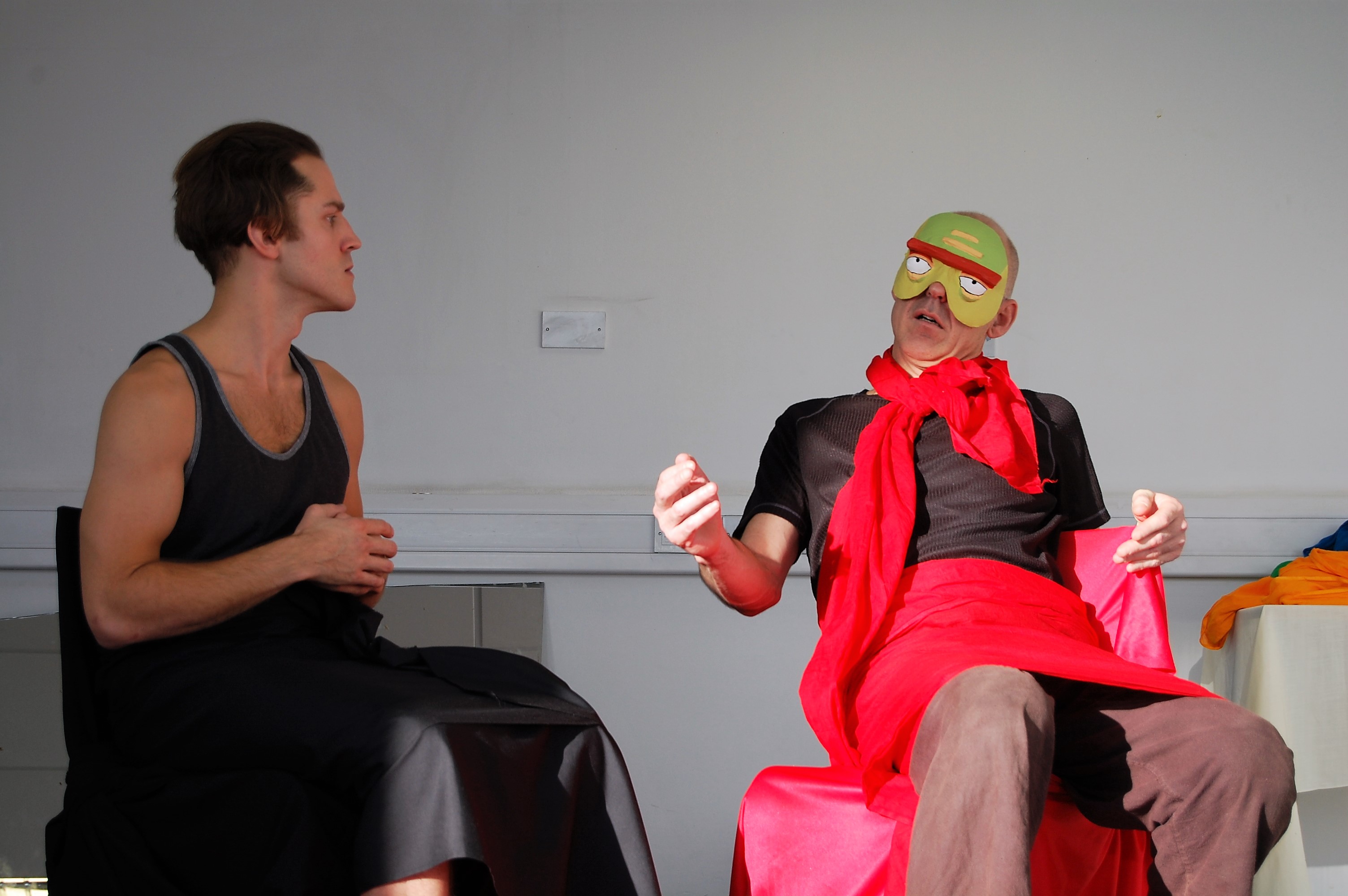
Keith Johnstone dedicated a chapter of Impro to status, and for good reason. The notion is deeply relevant to improvisers. It affects how we enter a space, how we relate to others, what kinds of characters we generate, and what kinds of stories we end up telling.
Status
"Humans evolved in hierarchical societies, and most of us acknowledge that status-seeking is a common, if sometimes regrettable, driver of human behaviour." – Steven Johnson, Wonderland
All social animals form pecking orders, and humans are no exception. Pecking orders regulate access to resources and reduce the need for constant open conflict. They stabilise a group until some shift in circumstance, power, competence, or desire unsettles the arrangement. A person's rank, her status, can be secured through competition or collaboration, and it can change from one setting to another. Someone who holds authority in one room may become hesitant or peripheral in the next.
In The Secret of Our Success, Joseph Henrich distinguishes between dominance-based and prestige-based status and argues that prestige is an evolutionary strategy in its own right, with its own logic and social function.
Prestige
Prestige-based status is achieved through freely granted deference grounded in perceived competence, knowledge, skill, or success. People choose to attend to, copy, learn from, and keep close to prestigious individuals. Henrich's central claim is that humans evolved prestige as a solution to the problem of cultural learning. In a species that survives by transmitting knowledge, it makes sense that we became highly sensitive to who is worth watching.
Dominance
Dominance-based status is achieved through coercion, intimidation, force, or the ability to impose costs on others. This form of status is widespread across primate species and human societies alike. It relies on pressure. Others yield because resistance carries a price.
Keith Johnstone dedicated a chapter of Impro to status, and for good reason. The notion is deeply relevant to improvisers. It affects how we enter a space, how we relate to others, what kinds of characters we generate, and what kinds of stories we end up telling.
As a person
What is your preferred place in the pecking order? Are you inclined to lead or to follow? Would you rather compete for attention or let others carry the spotlight? We are all status experts without necessarily knowing it. Much of adolescence is spent refining a workable relationship to hierarchy, attention, admiration, shame, and exclusion. We learn where we feel safe, where we feel exposed, and what kinds of status behaviour seem to protect or reward us. In improvisation, status games bring these habits into view in a concrete and light-hearted way. They let us observe our behaviour, recognise our preferred strategies, and try out alternatives.
As a player
Within a group, our status is always in motion. It shifts with confidence, timing, inspiration, fatigue, skill, social chemistry, or circumstance. To serve the ensemble well, we need to adapt to these changes rather than cling to a single preferred position. Sometimes the work calls for initiative. Sometimes it calls for restraint. Sometimes we need to lead the room. Sometimes we need to disappear long enough for someone else to find their feet. A flexible relationship to status makes this possible. It allows us to contribute without hardening around control or withdrawal.
As a character
A character's status can be high or low in relation to other characters, but it can also be exposed in relation to places, objects, ideas, memories, and feelings. A queen may dominate her court and shrink in the presence of her mother. A soldier may command troops and lose all certainty in a church. Status gives texture to behaviour. It shapes posture, rhythm, speech, silence, gaze, gesture, and reaction. With an awareness of status, character stops being applied from the outside and emerges organically through contact with the world.
As a storyteller
Shifts in status offer an endless reservoir of narrative possibilities. They generate tension, comedy, humiliation, seduction, reversal, loyalty, betrayal, growth, and collapse. In short form, a change in status can produce an immediate transformation. In longer forms, the disruption of an initial pecking order often provides the story's engine. Someone rises, someone falls, someone resists their faith, someone learns to inhabit it, someone discovers that the hierarchy itself was built on unstable ground. By the end, the original order may be restored, inverted, or replaced altogether. Again and again, stories return to status because status organises desire, and desire organises action.